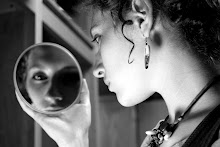
Lynn Hershman is actually one of the pioneers in multimedia, thinking of some very unique ways to use interactivity in the 1980s.

Let me start with Roberta, the fictionalized character with a real life. She was basically an alternative personality. Her records were kept with photographs, papers, and other tangible items. This piece is a good way to think about making something fictional seem real. My project was not going to use a physical human in the flesh or real objects. But by creating fake papers and altered photographs digitally, I could begin to build an alternate persona for the character in their fictional path. Roberta shows me that the more invested I am in the alternate story, the more I can emphasize the importance of decisions. By thinking out even the most minute aspects of someones life, such as the type of clothes they would wear in each story, could help me build an almost too believable alternate life. You can't just have the story, but the proof to back it up.
 Lorna best represents what I am trying to achieve with branching narratives. Each object in Lorna's room was a new start to a story. The viewer picked an object by pressing a number on a remote control and followed many branches to result in three possible endings.
For the whole semester I only thought in two branches: real and fictional. But that leaves only one decision up to the participant, and if I want a fully interactive piece, the viewer should constantly be a part of the flow of the storyline. It is useful to see how video can portray the narrative, even a false one. (Though I couldn't actually see it, because no videos of it would work on my computer.)
I think I got so caught up in trying to figure out what visual medium to use I stopped thinking about how to enhance the viewer experience. When I continue with this piece I hope to try and produce many branches like Hershman does, with more than one fictional ending. I think when the participant is repeatedly asked to make a decision it will draw their attention in more and keep them invested in the story. That will make it truly interactive, rather than just a menu with a button.
The last piece I think might be useful is her Electronic Diaries. These are all truthful accounts of her depression, eating disorder, and more. I like this one, because even though it is not interactive, it is very human. It is someone talking out her problems, and her friends and family discussing their viewpoint, and through all of this talking they are coming up with some real connections and conclusions. That is the one thing that is lacking in my narrative: the WHY? It could be interesting to bring World War I or The Great Depression into my grandparents story, because these are events that affected many of the decisions that led up to the moment where they meet.
I cannot decide at the moment if additional information would detract from or add to the overall work. I cannot necessarily combine all of Lynn Hershman's ideas into one piece, because too many facets could ruin an interesting story with human interaction. I am grateful to her though for using her personal life to create fictional people and stories, because it has allowed me to see a successful way of presenting such a narrative.
Using her tools for fictional, multiple-branched stories, and Krueger's idea of a responsive environment, I can hopefully continue to brainstorm and build upon my ideas to finally "get it." I feel like this semester I have not been as ecstatic about this project as some of my previous multimedia pieces because I was somewhat lost. I only wish I had realized the importance of utilizing other multimedia artist's ideas to expand upon my own.