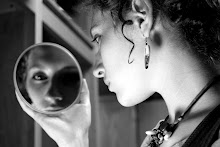
"A Season in Hell" works differently than other political/social works on the subject because often they depict the people affected. You'll see photographs of people jumping out of the World Trade Center, or a Katrina victim on a roof. This is an effective tool where the viewer feels an emotional response and a connection to the people that suffered.
Instead, this work chose to show the people responsible for the suffering. Instead of feeling bad for U.S. citizens, it provokes anger at the administration. It's important to see both. Feeling bad doesn't always change things, but anger can. Basically, this piece showed such an extreme opinion of the current government that even if you do not believe it...it will make you think about it as the cause for the so-called demise of the country.
9.10.2008

9.03.2008
What is the difference between noise and sound?
I suppose it depends who you ask. Luigi Russolo seems to think sound is made from natural entities and noise comes from man-made machines. Sound is any vibration that a living species can hear, whereas noise is usually a loud and disturbing sound. I think Russolo's comparison of the two does not really make sense considering noise is a sound also, and nature creates many odd noises, but I understand what he was trying to say. It doesn't quite matter how you define these terms as long as you utilize what the ear hears in a compelling manner.
Noise as art is completely reasonable. An artist is supposed to use their creativity and apply it to a medium. By changing the volume of one noise and increasing delay on another, someone is making an executive decision to alter a medium and create a new piece. Sound goes the same way. If sound is comprised of vibrations, by altering the vibrations to an aesthetically pleasing new sound (or unpleasing depending on the artist's goal), one is starting a new work of art. It doesn't matter what you call sounds and what you call noise, but if you combine and change them in the right way the result can offer a different emotional response to the viewer than a traditional medium. Sometimes if it is combined with a visual aspect as well, the message could be stronger, but I think there is something to be said for closing your eyes and imagining a picture or place based on sound alone.
Noise as art is completely reasonable. An artist is supposed to use their creativity and apply it to a medium. By changing the volume of one noise and increasing delay on another, someone is making an executive decision to alter a medium and create a new piece. Sound goes the same way. If sound is comprised of vibrations, by altering the vibrations to an aesthetically pleasing new sound (or unpleasing depending on the artist's goal), one is starting a new work of art. It doesn't matter what you call sounds and what you call noise, but if you combine and change them in the right way the result can offer a different emotional response to the viewer than a traditional medium. Sometimes if it is combined with a visual aspect as well, the message could be stronger, but I think there is something to be said for closing your eyes and imagining a picture or place based on sound alone.
9.01.2008
How do the movies in the exhibit differ from the media they question and satire?
Anne Ellegood's article, "Character Driven: Subjectivity and the Cinematic", uses different examples to show how reality and fiction can be blurred in cinema. It asks the audience to consider how much of real life is portrayed in the movies. Ellegood quotes Director Jean-Luc Godard who says that cinema is life, there is no difference (Ellegood 114). I think that in cinema, as long as you know that it is not real, you will not be deceived. Suspension of disbelief occurs, but once the movie is over, you come back to reality and can question what you just witnessed. Even in reality television and documentaries, it is widely known not to believe everything you see.
Many of the works on exhibition at the Hirshhorn use video and film to portray how we are tricked by the media. But if you look at at these pieces, how can you just believe what they are depicting, even if they are exposing at least one truth about society? Doing that would be the same as ignoring the message are they are trying to convey. It all becomes extremely complicated and convinces me that Godard is wrong and that cinema is always slightly off from the way things really work in life.


Kerry Tribe's piece Double is what really shows me that no matter how well you imitate something, it still can't be real. Five different actresses who look like the artist were hired to portray a video artist, and interpret this role using information they learned about Tribe. You cannot call these interpretations untrue, but they are definitely unreal. Even though they depict real scenes and use real background information, they cannot and will not ever be able to capture the true spirit of Kerry Tribe. Simple actors will never emit the passion of the individual herself. Yet, even if Tribe was acting as herself, could the audience believe everything is true? This piece helps to consider some of Ellewood's main questions: can virtual realism act as pure realism for an audience that will never know for sure? and what exactly is "truth" when put in the context of cinema?
I am convinced that you can not even trust that which you see with your own eyes. So nothing is real, yet everything is real. Tribe's work and Ellewood's article help to break that idea down and let the viewer perceive reality for themselves.
Mother + Father: How can forcing stereotypical gender roles on an audience be a good thing?
Most people don't want to see the truth about themselves. Especially if what is supposedly true for every man or woman, is not necessarily real for them.
Candice Brietz's Mother + Father depicts famous actors and actresses...well, acting. They play the "typical" men and women. Yet through these fictional characters, there is always a bit of truth. The mothers seem extra emotional and prone to admitting they were wrong. The fathers act as the provider and stress education and discipline. Though the original context in each movie may have been to show the differences in parenting between mother and father, this piece seemed to make it easier to pick out the parallels.
Both genders are part of the larger humanity and want people to care about them, but ultimately want what is best for the child. Both are selfish and compassionate, reserved and angry. By utilizing comparisons of extreme gender stereotypes, Mother + Father isolates the raw emotion of woman and man and helps the opposite sex to understand and relate to the other.
Candice Brietz's Mother + Father depicts famous actors and actresses...well, acting. They play the "typical" men and women. Yet through these fictional characters, there is always a bit of truth. The mothers seem extra emotional and prone to admitting they were wrong. The fathers act as the provider and stress education and discipline. Though the original context in each movie may have been to show the differences in parenting between mother and father, this piece seemed to make it easier to pick out the parallels.
Both genders are part of the larger humanity and want people to care about them, but ultimately want what is best for the child. Both are selfish and compassionate, reserved and angry. By utilizing comparisons of extreme gender stereotypes, Mother + Father isolates the raw emotion of woman and man and helps the opposite sex to understand and relate to the other.
Subscribe to:
Posts (Atom)